
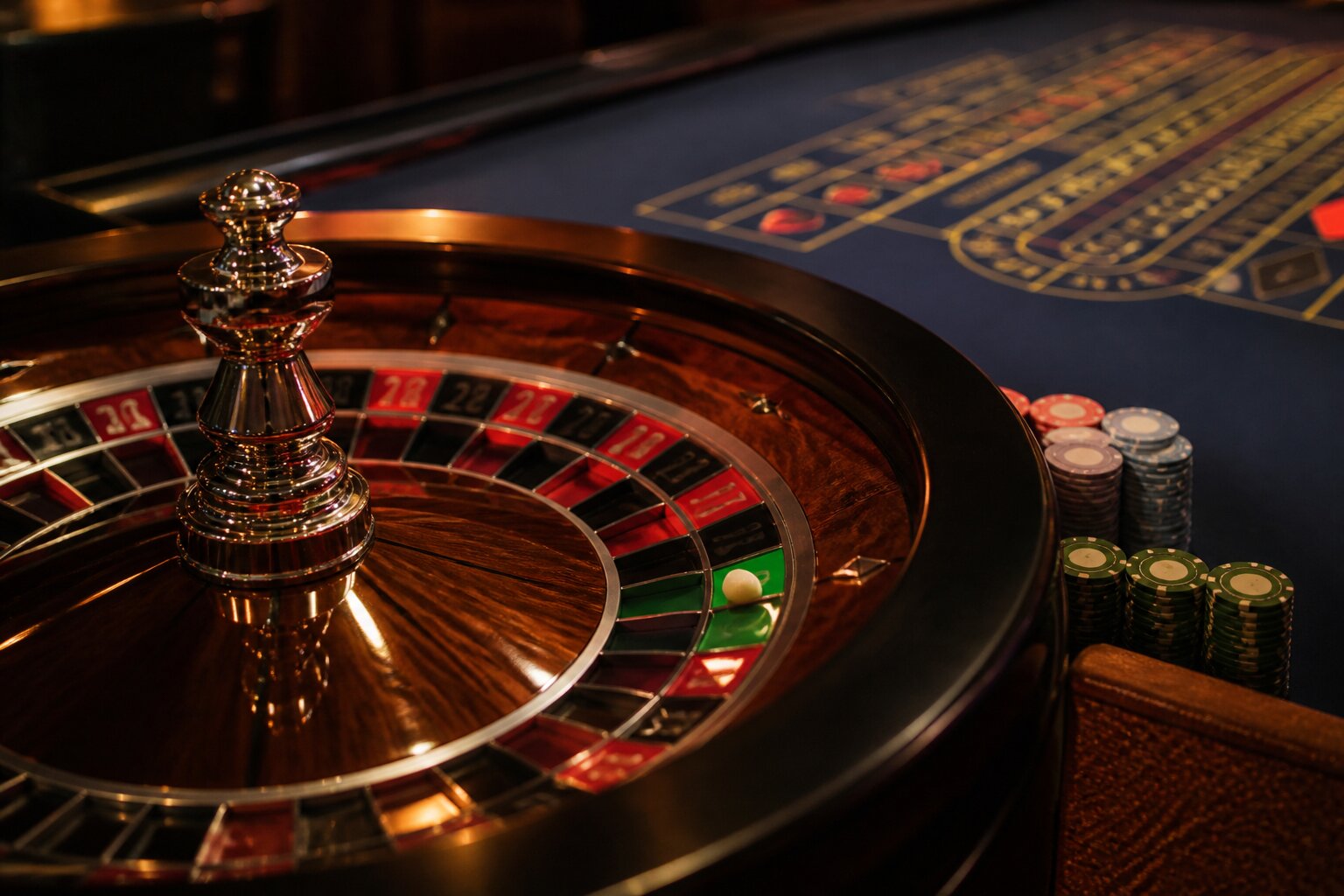
Ever placed a bet on roulette and watched the ball drop into the single green 0 or its double cousin, 00? That moment raises a common question: how much does that win actually pay?
Those green pockets are more than decoration. They alter the odds and payouts, and they change how certain bets behave on the wheel. This matters whether you’re playing at a casino or online, because the presence of 0 or 00 affects both the size of a one-off payout and the longer-term maths behind the game.
Read on to find clear examples of typical payouts, how the two types of wheel differ, and why the green pockets exist in the first place.
What Do 0 and 00 Mean in Roulette?
The 0 and 00 are the only green pockets on a roulette wheel and they serve a specific purpose: to create outcomes that sit outside the usual 1–36 numbers. European wheels have a single 0; American wheels have both 0 and 00. Their colour makes them easy to spot and marks them as special compared with the numbered pockets.
When the ball lands in one of these pockets, many outside bets—such as red/black or odd/even—don’t win because those bets only cover the numbers 1–36. That interaction is what gives the house its edge. The inclusion of a single 0 or an extra 00 changes the balance between player-facing bets and the casino’s mathematical advantage.
Next, we’ll look at how a win on those green pockets is paid out, with clear examples you can picture at the table.
How Are Winnings Calculated for 0 and 00 Bets?
Straight-up bets placed directly on 0 or 00 pay at the standard single-number rate: 35 to 1 on both European and American wheels. For instance, a £1 bet on 0 that wins returns £35 in winnings plus the original £1 stake, giving £36 in total.
Combination bets that include 0 or 00 follow the usual roulette ratios for those bet types. A split bet covering two numbers pays 17 to 1, so a £1 successful split returns £17 plus the stake (£18 total). Other common examples are street and corner bets, which pay 11 to 1 and 8 to 1 respectively when they cover 0 alongside other numbers. On American wheels there is an additional basket bet covering 0, 00, 1, 2 and 3 that pays 6 to 1.
Payouts are set relative to the number of possible outcomes, not to guarantee a win. The precise examples above show how much a single-pound stake would return for each winning bet, and how those returns compare across the common wager types.
Payouts for Different Bet Types on 0 and 00
This section lists the most common bets that include 0 or 00 and shows how much each returns on a £1 stake. These apply equally to the green pockets as to any other number covered by the same bet.
Straight Up Bet Payouts for 0 and 00
A straight-up bet is placed on a single number, like 0 or 00.
Payout: 35 to 1
Example: Bet £1 on 0. If 0 comes up, you win £35 plus your £1 stake, totalling £36.
This is the highest payout for a single-number bet in roulette.
Split, Street, and Other Bet Payouts on 0 and 00
Several combination bets can include 0 or 00, especially on wheels that have both green pockets.
Split Bet (covers two adjacent numbers):
Payout: 17 to 1
Example: Bet £1 on a split between 0 and 1. If either appears, you receive £17 plus your £1 back (£18 total).
Street Bet (covers a row of three numbers):
Payout: 11 to 1
Example: Bet £1 on 0, 1 and 2. A win pays £11 plus your £1 (£12 total).
Corner Bet (covers four numbers):
Payout: 8 to 1
Example: Bet £1 covering 0, 1, 2 and 3. A successful hit returns £8 plus your £1 (£9 total).
Basket Bet (found on wheels with both 0 and 00, covers 0, 00, 1, 2, 3):
Payout: 6 to 1
Example: Bet £1 on the basket. If any of those five numbers come up, you win £6 plus your £1 stake (£7 total).
Each payout ratio applies equally to any number within the bet. These examples make it easier to compare potential returns and see how including 0 or 00 alters the risk–reward of a wager.
Having covered payouts, it helps to compare how these figures play out across the two main wheel types.
European vs American Roulette: Key Differences in 0 and 00
The practical distinction between the two wheel types is simple: European roulette has a single 0; American roulette adds an extra 00. That one extra pocket changes the count of possible outcomes from 37 to 38, which in turn affects the probability of any single number being hit.
Payouts for bet types—such as the 35 to 1 for a straight-up—remain the same on both wheels. What changes is the chance of winning. On a European wheel, the odds of any single number are 1 in 37 (about 2.70%), while on an American wheel they are 1 in 38 (about 2.63%).
Because of this small shift in probability, the long-term data favours the single-zero wheel: the house edge is 2.70% for European roulette and 5.26% for American roulette. That difference affects how long a player’s stake is likely to last and the expected returns from repeated play.
Next we’ll explore why those green pockets were added in the first place and what they mean for the house’s advantage.
Why Do Most Roulette Tables Include a 0 and Sometimes a 00?
The green pockets exist primarily to create a built-in advantage for the house. If roulette only had the numbers 1–36, even-money bets would be true 50/50 propositions. By adding 0—and in some versions 00—there are outcomes that fall outside those bets, so a proportion of spins result in losses for outside wagers.
Historically, the single 0 was introduced to ensure the operator could run the game sustainably while still offering a competitive payout structure. The extra 00 was later added on some wheels for similar reasons. Both pockets serve the same mathematical purpose: they prevent certain bets from being fair 50/50 propositions and ensure a consistent house edge.
Understanding this role of the green pockets clarifies why payout rules differ from the pure odds of hitting a number. The next section explains how those differences translate into the house edge figures mentioned earlier.
House Edge Impact: 0 and 00 Explained
The house edge is the percentage of every bet that the casino expects to retain over many plays, and it stems directly from the presence of the green pockets. With a single zero and 37 possible outcomes, the European wheel creates a house edge of 2.70% for most bets. That means, across a large number of spins, a player would lose an average of £2.70 for every £100 wagered.
Adding the 00 brings the total outcomes to 38 and raises the house edge to 5.26% on American wheels. That higher percentage increases the average long-term loss per £100 staked to £5.26. While those percentages don’t guarantee any single result, they are useful for comparing which wheel offers better expected value over time.
Because the house edge is rooted in the wheel’s structure, payout amounts don’t change to compensate for the extra pocket; instead the probabilities shift. That is why choosing the wheel with a lower house edge can materially affect how a player’s balance behaves during a session.
For players focused on value, the single-zero wheel generally offers the better mathematical position, though every session is still subject to the built-in edge.
Play Casino Games at Umbingo
We welcome you to become part of our friendly community at Umbingo, where playing casino games is all about enjoying the experience together. Discover what makes our site a great place for entertainment and shared excitement.
Getting started is simple: just create an account, make your first deposit and you can begin playing casino games with us. We look forward to seeing you join our players and enjoy your time at Umbingo.
**The information provided in this blog is intended for educational purposes and should not be construed as betting advice or a guarantee of success. Always gamble responsibly.