
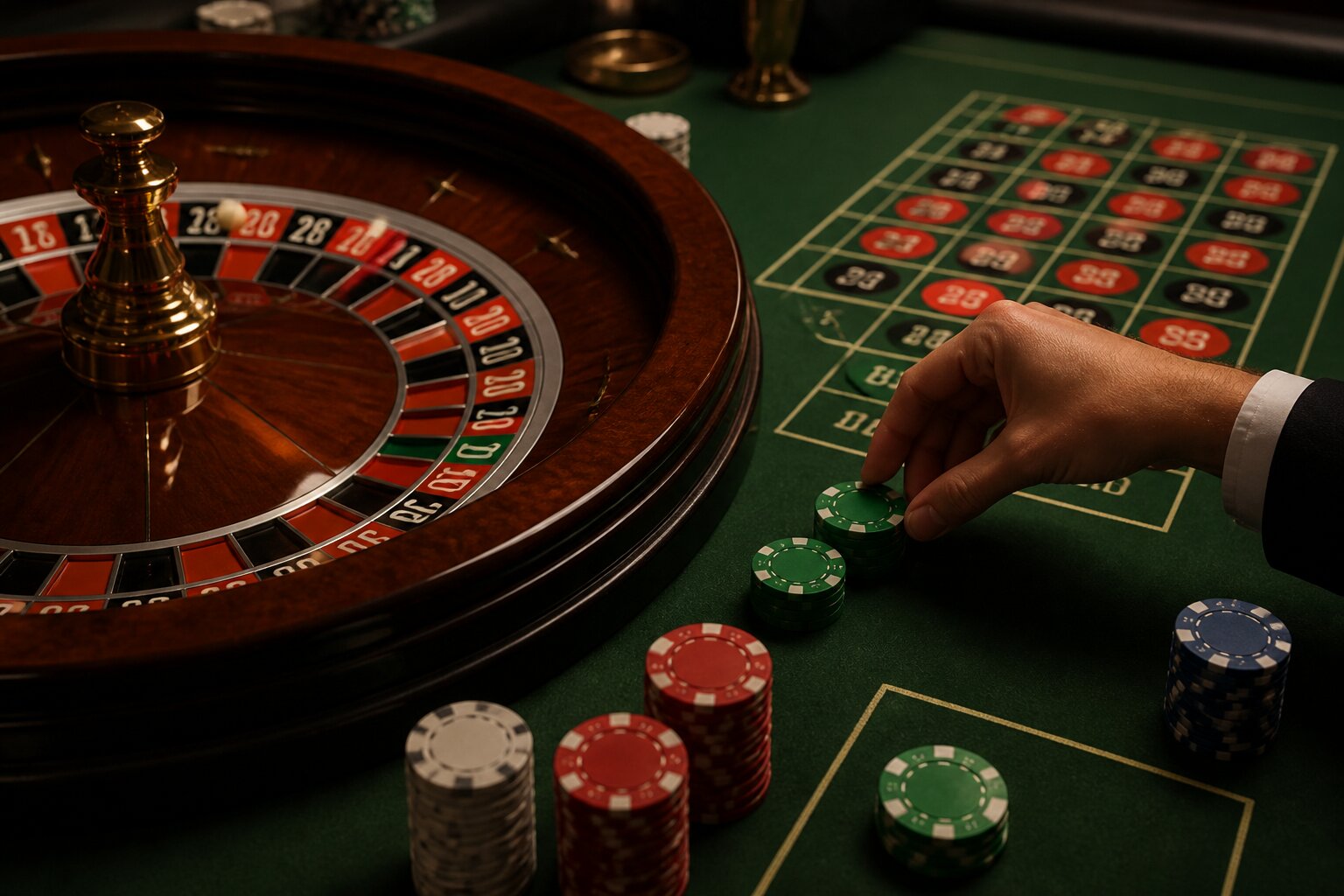
Ever wondered what the green spaces on a roulette wheel actually mean for your game? You’re not alone. Those green pockets change the maths of every bet and often decide whether a spin favours the table or the player.
This guide explains what the green pockets represent, how they affect payouts and odds, and why the house keeps an edge. Read on — each section builds on the last so you’ll get a clear picture of how green bets fit into the game.
What Does the Green Pocket Represent in Roulette?
The green pocket is the slot for zero. In European roulette there is a single zero, while American roulette adds a double zero. Those extra pockets are not decorative: they alter the relationship between payouts and the actual chances of a win.
Most common bets to do with colour, parity, or high/low lose if the ball lands on a green pocket. That outcome shifts money to the house over time because typical payouts are calculated as if the green spaces were not present. The green pocket also gives you specific wager options, such as betting directly on zero or placing splits that include it. These options offer higher nominal payouts but come with lower chances of success, which is a direct consequence of there being fewer green slots than the rest of the wheel.
Understanding this helps make sense of why some bets seem generous on paper but are harder to win in practice.
How Many Green Pockets Are on the Wheel?
The number of green pockets depends on the roulette variant. European wheels have one green pocket for zero, while American wheels have two: zero and double zero. That single additional pocket in American roulette changes the total number of possible outcomes from 37 to 38.
This difference may look small, but it affects every bet. For example, the payout for a straight-up number remains 35 to 1 in both versions, yet the probability of winning that payout is lower on the American wheel because there is one extra possible result. In practice, that means the chances of landing on a green pocket are lower in proportion on American wheels, and casino returns are correspondingly higher.
Always check which wheel is in play before placing larger bets so you understand how it shapes the odds.
Which Bets Involve the Green Numbers?
A few specific wagers centre on the green pockets. The most direct is the straight-up bet on zero (or on zero and double zero in American roulette), where a chip is placed directly on the green slot. This covers a single number and therefore commands the highest single-number payout.
There are also split bets that combine zero with neighbouring numbers on the layout, such as 0/1 or 0/2 in European roulette. These cover two outcomes and pay less than a straight-up. On American wheels a split can include the 0/00 pairing in some layouts. Additionally, the American “basket” or “top line” bet groups 0, 00, 1, 2 and 3; it covers more numbers and returns a lower payout to match the wider coverage.
Each of these options balances risk and reward differently: the more numbers covered, the lower the payout, and vice versa. That relationship is rooted in the number of pockets on the wheel, explained earlier, so you can compare bets with the wheel type in mind.
What Are the Payouts for Green Bets in Roulette?
When a straight-up bet on any single number wins, the standard payout is 35 to 1. That applies to zero in European roulette and to zero or double zero when betting those individually on an American wheel. A £1 straight-up that wins would return £35 in winnings plus the £1 stake.
Split bets that include a green number pay 17 to 1 because they cover two possible outcomes. The American basket or top line bet—covering five numbers including both green pockets and the first three numbered slots—pays 6 to 1, reflecting the broader coverage.
These payouts are fixed by the table rules, but their value must be read alongside the actual probability of each outcome. Payouts do not change between European and American wheels, yet probabilities do, which is why the house edge differs between the two versions.
What Are the Odds of Winning a Green Bet?
The odds of a green outcome are driven solely by how many pockets appear on the wheel. On a European wheel with 37 pockets, the probability of hitting the single zero with a straight-up bet is 1 in 37, roughly 2.7%. On an American wheel with 38 pockets, the chance of landing on a particular green pocket is 1 in 38, about 2.63%.
If you place a bet that covers more than one green-related outcome—such as the American top line—the chance of a win adjusts according to how many pockets are covered. For example, the top line covers five numbers out of 38, so its probability is roughly 5 in 38.
These percentages clarify why green bets pay well but occur infrequently. The payouts compensate for low probability, not because the outcome is more likely.
How Is the House Edge Calculated for Green Bets?
The house edge is the mathematical advantage built into roulette through the presence of green pockets. A straight-up payout of 35 to 1 suggests a 36-way or 37-way fairness, but the wheel has 37 pockets in European roulette and 38 in American roulette. That mismatch between payout and actual number of outcomes creates a long-term advantage for the casino.
For European roulette the house edge is about 2.7 percent. That comes from the single zero among 37 possible outcomes and is reflected across all bets on the table, not just those involving green pockets. American roulette has a higher edge, around 5.26 percent, because of the extra double zero and the total of 38 outcomes. The house edge applies no matter the bet size or type; it is a feature of the game’s structure rather than any particular wager.
Knowing the edge helps set realistic expectations about returns over many spins.
European vs American Roulette: Key Differences for Green Bets
The key difference is how much each variant favours the player or the house. European roulette with one zero offers a lower house edge, which makes straight-up and other bets marginally more favourable on average. American roulette’s extra double zero increases the house advantage so the expected return to players falls accordingly.
Beyond the edge, table layout and available bets can vary between venues, and some casinos offer rules or side bets that adjust the economics of zero-related wagers. Those differences should be considered as part of the choice between wheel types.
If you prefer a single, clearer rule set with a lower built-in disadvantage, the European wheel is typically the better option.
Are Green Bets Worth Placing? Common Myths Explained
Green bets attract attention because they yield high payouts when they hit. That does not make them a superior long-term choice. High payout equals low probability; the math discussed above makes that trade-off plain.
A frequent misconception is that a number or colour becomes “due” after a run of other results. Each spin is independent, and past results do not change the underlying probabilities of future spins. Another myth is that green bets offer a hidden advantage because of their payout; in truth the payout is calibrated to the probability of the outcome and does not overcome the house edge.
Green bets can add variety and excitement to a session, but they work the same way as other bets: occasional wins are possible, but the structure of the game means the house retains a steady advantage over many spins. Keep that perspective when choosing whether to place these wagers.
Summary of Green Payouts, Odds & House Edge
Here is a concise recap to take away from this guide.
Key Takeaways
- The green pockets (0 in European, 0 and 00 in American) introduce the house edge that affects every bet.
- Straight-up green bets pay 35 to 1, but the chance of hitting them is around 1 in 37 on European wheels and 1 in 38 on American wheels.
- Myths about numbers being due or green bets being more profitable do not hold up against the underlying probabilities.
Responsible Play
Roulette outcomes are determined by the game’s design, not patterns or certainty. Treat betting as entertainment and set limits that reflect what you can afford. If you need support with controlling play, use the safeguards and resources offered by operators.
If you’d like to explore how different bets compare in probability or see examples of how payouts and odds interact for specific wagers, there are tools and calculators available on the site to help you decide what suits your approach.
**The information provided in this blog is intended for educational purposes and should not be construed as betting advice or a guarantee of success. Always gamble responsibly.