
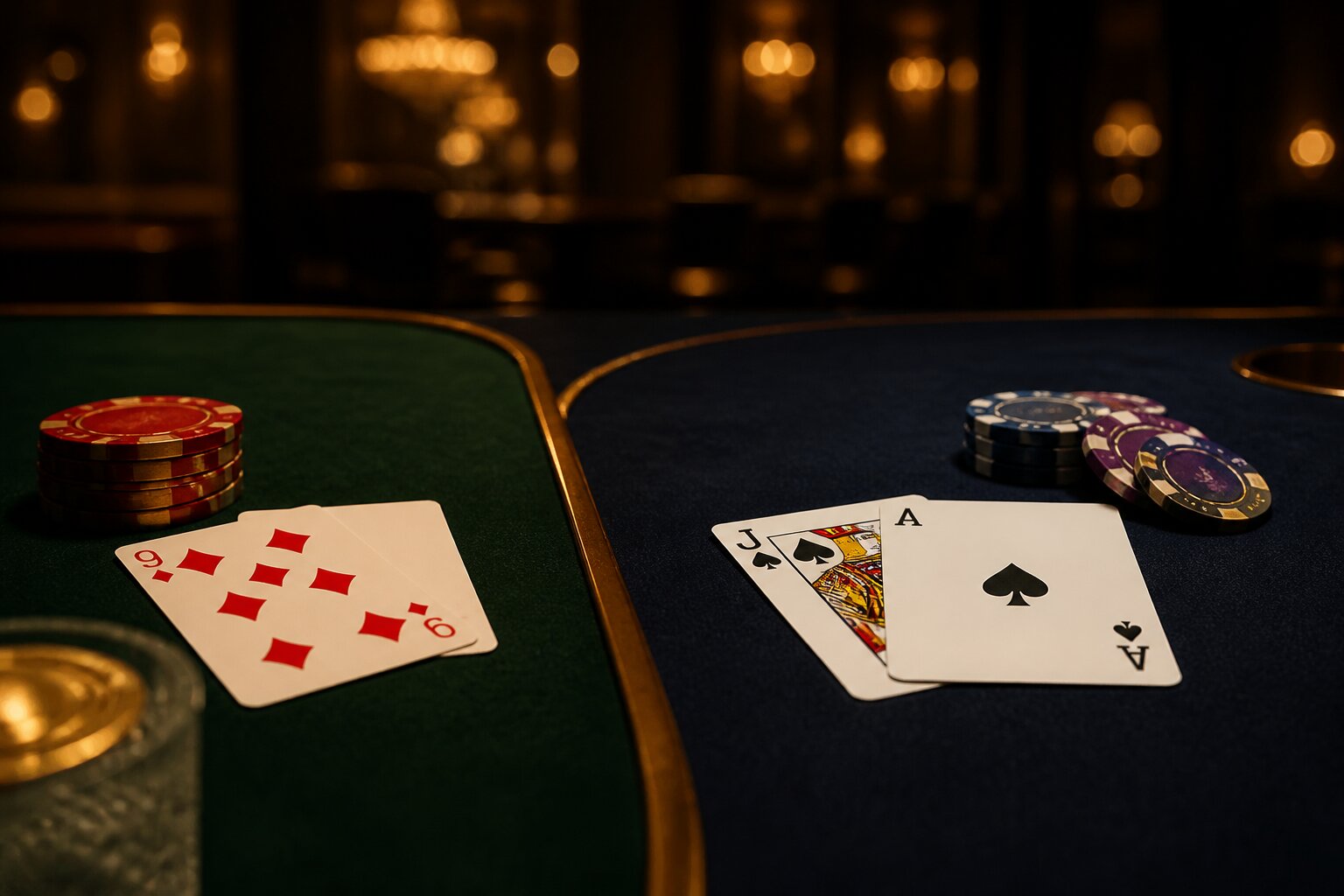
When you visit an online casino, two card games always stand out: baccarat and blackjack. Both are staples on casino floors and online lobbies, yet they offer very different experiences.
Maybe you enjoy the calm simplicity of baccarat or the decision-making of blackjack. Perhaps you’re weighing odds, ease of learning, or simply which style of play suits you best.
If you’ve ever wondered how these classics stack up, keep reading. This guide breaks down rules, odds, typical bets and what you can expect at the table so you can choose the game that fits how you like to play.
What Are the Main Differences Between Baccarat and Blackjack?
Baccarat and blackjack both use cards, but they ask different things of the player. Baccarat centres on a simple bet: which hand—'player' or 'banker'—will be closer to nine, or whether the round ends in a tie. Once bets are placed, the dealer follows set drawing rules and there’s little for players to do beyond watching.
Blackjack is much more interactive. Your aim is to get a hand value closer to twenty-one than the dealer without exceeding it. During each round you make decisions such as whether to take another card, keep your total, double down or split pairs. Those choices shape the outcome, so knowledge of basic strategy can make a meaningful difference.
Card valuations differ too. In baccarat, tens and face cards count as zero and aces as one; other cards carry their face value, and totals are reduced modulo ten (so only the last digit counts). In blackjack, face cards and tens count as ten, aces can be one or eleven depending on what helps the hand, and numeric cards keep their printed value.
These contrasts set the tone: baccarat is more observational, blackjack is more tactical.
How Are the Rules and Gameplay Distinct?
Baccarat rounds begin with players placing bets on one of the three outcomes, then the dealer deals two cards to each side. A third card may be dealt according to automatic rules that depend on the initial totals; players do not make those decisions. The hand nearest nine wins and payouts depend on your bet choice.
Blackjack starts with two cards to each participant, typically with one dealer card face up. Players compare their visible hand to the dealer’s and choose actions that affect their own totals. The round resolves when players stand or bust, and then the dealer plays by house rules. If your total is higher than the dealer’s without exceeding twenty-one, you win; ties are generally pushes.
Both games have rule variants that affect play—such as the number of decks used, whether the dealer hits on a soft seventeen in blackjack, or the commission on banker bets in baccarat. Knowing the specific rules at a table helps you understand the likely pace and potential returns.
If you want a quick sense of the flow, baccarat runs with minimal player input while blackjack keeps you engaged every hand.
House Edge: Which Game Offers Better Odds?
House edge expresses the casino’s long-term statistical advantage and varies by bet and rules. In baccarat, common figures are around 1.06% for banker bets and about 1.24% for player bets, with tie bets carrying a much larger house edge—often well above 10%—so they are generally less favourable.
Blackjack’s house edge depends heavily on the precise house rules and how closely a player follows basic strategy. Under player-best conditions, it can be lower than baccarat’s and sit around 0.5%, but rule changes or poor decisions quickly raise that percentage.
These numbers reflect long-run tendencies rather than outcomes of single hands. Understanding them helps you decide which game aligns with your appetite for risk and the type of session you want to play.
Payouts and Betting Options Compared
Standard payouts differ between the two games. In baccarat, player and banker bets typically pay even money, with banker wins often subject to a small commission to offset its slightly better odds. Tie bets pay higher multiples—commonly 8:1 or 9:1—but they occur far less frequently.
In blackjack, a normal win pays even money while a natural blackjack (an ace plus a ten-value card on the first two cards) usually pays 3:2. Pushes return your stake. Variations to blackjack payouts can influence the house edge, so it’s worth noticing whether a table pays 3:2 or the less favourable 6:5 for naturals.
Both games commonly feature optional side bets—extra wagers on specific outcomes or combinations. These side bets can offer large payouts but generally come with far higher house edges than the main bet, so they are best treated as occasional, entertainment-focused options rather than core strategy.
If you prefer steadier, lower-variance play, stick with the main bets; if you want the occasional big payout at much higher risk, explore side bets selectively.
Side Bets: Are They Worth Considering?
Side bets add variety and larger headline payouts but nearly always increase the house’s advantage. Examples include pair bets in baccarat and combination bets in blackjack that pay out if certain card patterns appear. They can be fun for short-term excitement, yet they shouldn’t replace the main wager if your priority is statistical value.
Treat side bets as optional extras and set a clear portion of your budget for them so they don’t skew your overall session.
Player Experience: Which Game Is More Beginner-Friendly?
Baccarat’s main appeal for newcomers is its simplicity: a few betting choices, predictable routines and no required decisions after cards are dealt. For players who prefer a low-pressure environment where outcomes play out without active involvement, baccarat can be immediately accessible.
Blackjack offers a steeper learning curve because the quality of your decisions affects results. That effort can be rewarding: learning basic strategy reduces the house edge and gives you a sense of control. For players who enjoy thinking through choices and adapting to different hands, blackjack can be more engaging.
Trying free versions or demos is a low-risk way to explore both games. They help you understand pacing, table etiquette and the look of the interface before wagering real money.
If you like a calm, watch-and-bet format, baccarat tends to be friendlier; if you enjoy decision-making and learning strategy, blackjack may hold more appeal.
Common Misconceptions About Baccarat and Blackjack
Several persistent myths surround both games. One is that systematic betting patterns can overcome the house edge; mathematical analysis shows they cannot erase the built-in advantage. Another is the idea of “streaks” meaningfully altering future outcomes—each deal is independent and past results don’t change the probabilities for the next hand.
Some people assume only experienced players or high-stakes gamblers can enjoy these games. In truth, both scales of play are accessible: you can join low-stakes tables or play social versions while you develop familiarity.
Finally, superstitions such as favoured seats or rituals may make the experience more personal, but they do not affect how the cards are dealt. Keeping a clear view of the true mechanics helps set realistic expectations and keeps play focused on enjoyment.
How to Choose the Right Game for You
Choosing between baccarat and blackjack comes down to what you value in play. If you want minimal decisions and a steady rhythm, baccarat provides that. If you prefer interactive rounds where choices influence outcomes and you like learning tactical approaches, blackjack rewards that interest.
Consider also how much attention you want to give during a session and the pace you enjoy. Both games exist in different stakes and formats, so you can start small and adjust once you know what suits you.
Decide what you want from your time at the tables—relaxed observation, active strategy, or a mix—and pick the game that best matches that mood. Keep any extra bets modest so they remain part of the entertainment rather than the main focus.
Final Thoughts: Baccarat or Blackjack?
Both games have clear strengths. Baccarat gives a simple, low-decision experience with straightforward betting; blackjack offers interactive play where decisions matter and strategy pays off. Your choice should reflect whether you favour calm observation or engaged play.
Whichever you try, approach play with a clear plan and a set budget. Treat both games as entertainment and play within limits that work for you. Enjoy the table, know the rules of the specific game variant you choose, and pick the one that feels most rewarding for how you like to play.
**The information provided in this blog is intended for educational purposes and should not be construed as betting advice or a guarantee of success. Always gamble responsibly.