
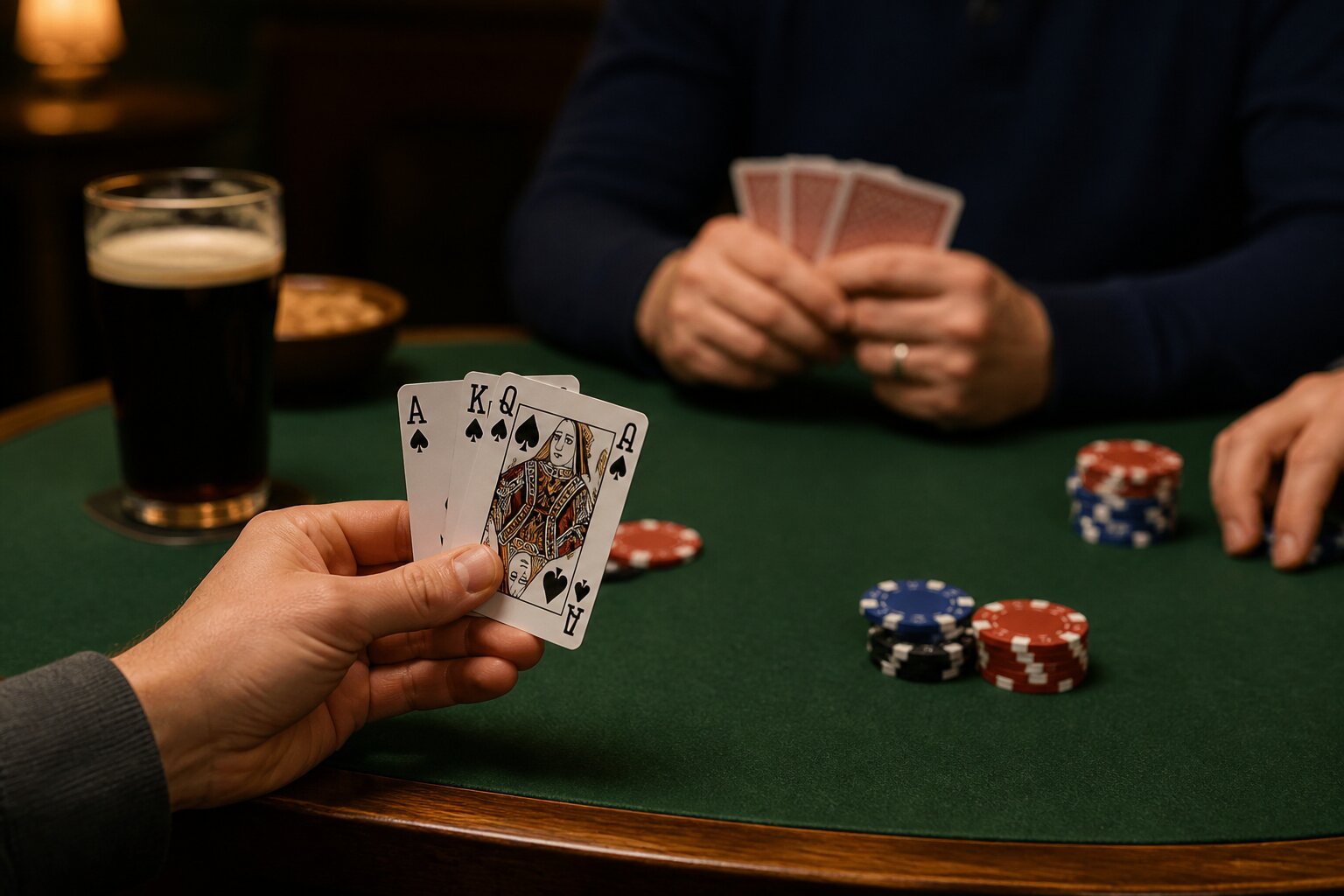
Ever found yourself around a pub table, a battered deck of cards in hand, and someone suggests a game of 3 Card Brag? Maybe you thought, “Isn’t this just a British version of poker?” or wondered why your mate keeps talking about ‘prials’ and ‘running flushes’ as if they’re the ultimate hands. Despite its long history in Britain, 3 Card Brag still manages to baffle even regular card players because of its mix of straightforward play and a few old-fashioned rules.
If you’ve ever questioned whether a running flush beats three of a kind in Brag, or pondered how risky bluffing is here compared with other card games, you’re not alone. There’s confusion over hand rankings, betting flow and how to enjoy the game sensibly.
Before you start shuffling, it helps to clear up the main misconceptions so the next time someone calls your bet, you’ll know exactly where you stand.
What Is 3 Card Brag?
3 Card Brag is a traditional British card game that has been played in pubs and homes for generations. It emerged in the eighteenth century and is one of the familiar ancestors of modern card games, yet it keeps a character all of its own thanks to short rounds and a distinct set of hand rankings.
The core idea is simple: each player receives three cards and the objective is either to hold the best hand or to persuade opponents to fold through betting. There are no community cards, and rounds resolve quickly, which keeps the pace lively. Variants exist, such as classic Brag and casino-style 3 Card Brag, but they share the same basic rhythm of anteing, betting and showdowns.
This simplicity makes it easy to learn while still offering strategic choice: whether to press a bet with a modest hand, fold early to conserve funds, or risk a higher stake to try and win a larger pot. Read on to see how a typical round plays out in practice.
How Do You Play 3 Card Brag?
A typical session begins with everyone placing an equal ante into the pot. The dealer then deals three cards face down to each player from a standard 52-card deck. Players look at their own hands in private and decide how to act.
Play moves clockwise. On a turn a player may bet, match an existing bet, raise, or fold. Folding ends a player’s involvement in that hand and they forfeit their ante. Betting continues around the table until either all but one player have folded or the remaining players agree to compare hands.
When two players reach a head-to-head situation, one may offer to “see” the other’s cards by paying an agreed amount, often double the last bet. If the see is paid, both hands are shown and the higher ranking hand wins the pot. If one player declines to see and folds instead, the other collects the pot without revealing their cards.
Because rounds are brief, decisions tend to be faster than in multi-street poker variants and table dynamics change quickly. With that in mind, the next section clarifies the precise rules that guide betting and hand resolution.
Key Rules Explained
Each round starts with the ante, ensuring there is something to play for from the outset. After dealing, players privately inspect their three cards and the first betting round begins with the player to the dealer’s left.
Betting proceeds clockwise; players may call, raise or fold. If a raise occurs, subsequent players must match or raise further to stay in. Folding immediately removes a player from contention for that pot. In many home games there is a customary limit on raises to keep play moving and to avoid runaway stakes.
When only two players remain, one can offer the “see” payment. Paying to see forces both hands to be revealed and settles the pot; declining to pay concedes the pot to the opponent. In some variations the exact multiplier for a see can differ, so it’s useful to agree the terms before play begins.
Hand rankings in Brag are distinctive. A prial, meaning three of a kind, ranks highest. Below that is a running flush, which is three consecutive cards of the same suit. Next comes a run, or straight, which is three consecutive cards of mixed suits. A flush is three cards of the same suit that are not consecutive, followed by a pair, and finally high card when no other combination is present. Understanding this order is important because it affects both betting choices and the outcome of showdowns.
With the rules clear, it’s worth addressing some common misunderstandings that often trip players up.
Common Misconceptions About 3 Card Brag
3 Card Brag attracts a number of myths, largely because it resembles poker superficially. One widespread error is assuming poker strategies translate directly to Brag; while bluffing has a role, the short hands and quick rounds change how often and how effectively deception works.
Another misconception concerns the importance of a “poker face.” While keeping a calm demeanour can influence casual opponents, Brag’s rapid pace and the small number of cards mean psychological play tends to be briefer and more opportunistic than in longer poker formats. Players often make swift calls or folds based on the bet size and pot odds rather than elaborate table reads.
Some players also misunderstand the hierarchy of hands, thinking that standard poker order applies. As already outlined, a prial outranks a running flush and a run beats a flush. Mistaking these rankings can lead to costly showdowns, so it’s wise to be explicit about the hand order before any game begins.
Next, we’ll explain those hand rankings in full, with examples to remove any lingering doubts.
Understanding the Ranking of Hands
The ranking of hands in 3 Card Brag is compact but specific. From strongest to weakest the order is:
- Prial (three of a kind). Example: 3♥ 3♣ 3♦.
- Running Flush (straight flush). Example: 4♠ 5♠ 6♠.
- Run (straight). Example: 7♦ 8♣ 9♥.
- Flush. Example: 2♣ 7♣ Q♣.
- Pair. Example: J♠ J♦ 5♣.
- High Card. Example: A♠ 7♦ 4♣.
A prial always defeats a running flush, and a run beats a non-sequential flush. In practice this means some hands that look strong in poker are outclassed in Brag by three of a kind or certain sequential combinations. When comparing hands of the same category, standard card-ranking rules apply: highest card wins, and suits are not ranked unless players agree otherwise.
Knowing this order helps inform betting choices: for example, a pair is solid but vulnerable to runs and prials, so weighing the current pot against the likelihood of facing a superior hand is helpful. With the mechanics and rankings set out, the final section offers practical guidance for new players.
Essential Dos and Don'ts for New Players
Approaching Brag with a sensible mindset makes the game more enjoyable and sustainable. Set a clear spending limit for each session so you do not exceed an amount you are comfortable losing. Decide this before play starts and treat it as part of the game’s rules.
Learn the hand rankings and the variation rules for the table you are playing at; a short clarification at the start prevents disputes later. Take regular breaks to keep decisions clear-headed, and avoid playing while upset or distracted, since that tends to lead to poorer choices.
Resist the urge to chase losses by escalating bets to recover earlier losses. Doing so often results in larger losses. Keep the session social and moderate, remembering that anyone joining must be at least 18 years old. These habits preserve the fun and help maintain fair play for everyone involved.
Enjoy the challenge of quick decisions and the social side of the game, and you’ll find 3 Card Brag a rewarding pastime to return to.
Play Casino Games Online at Umbingo
We’d love to welcome you to our world of entertainment, where there’s something for everyone. Take your pick from a wide selection and experience the fun and excitement of online casino games with us.
Getting started is straightforward: just create your account, make a deposit and you’re ready to play. We look forward to seeing you at Umbingo.
**The information provided in this blog is intended for educational purposes and should not be construed as betting advice or a guarantee of success. Always gamble responsibly.