
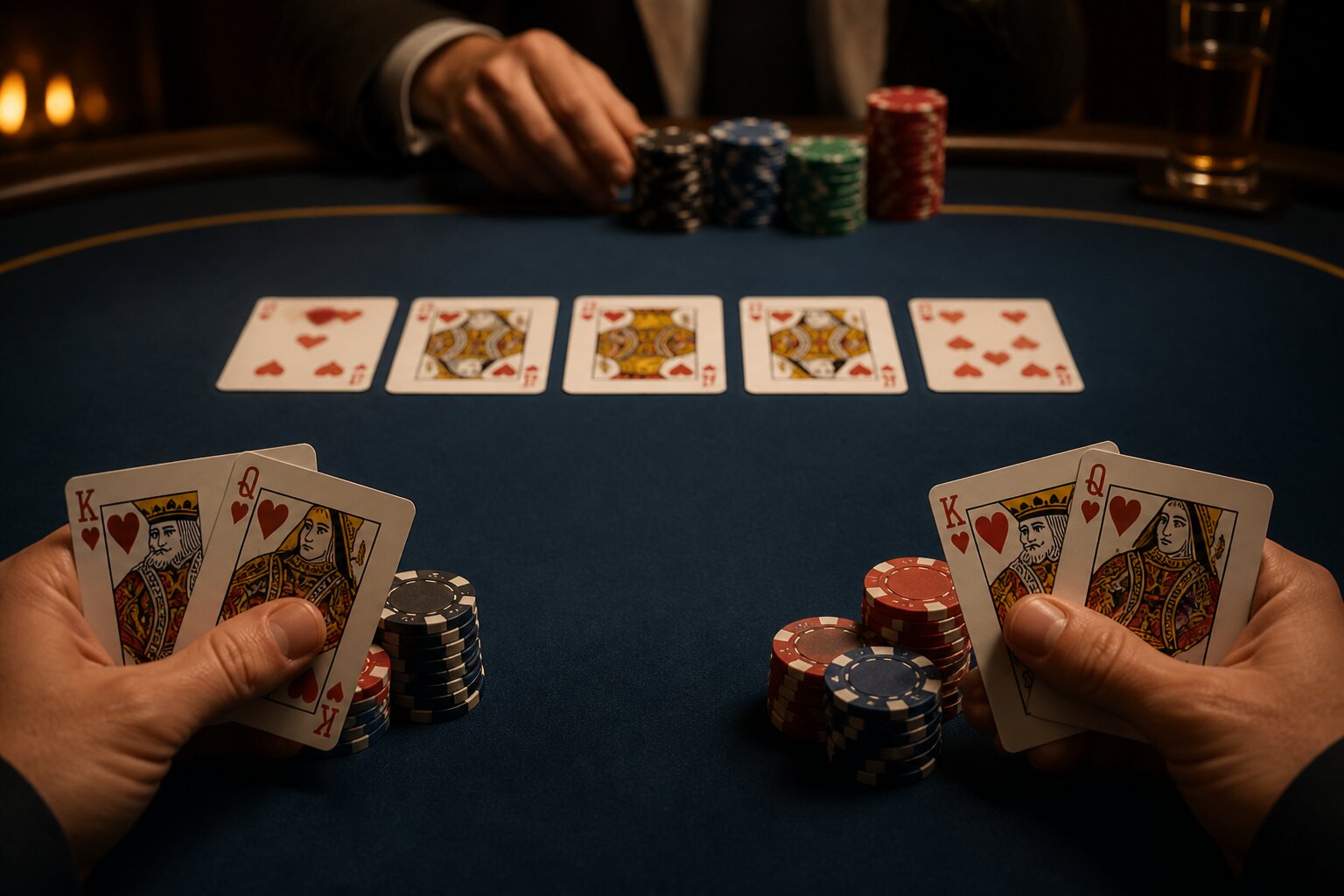
Ever found yourself watching a tense poker game, only for two players to reveal what looks like identical hands? It’s one of those moments that can stop the table, leaving everyone wondering what happens next.
Knowing how identical hands are resolved matters whether you’re new to the game or have been playing for years. The rules determine whether a player scoops the pot or the winnings are shared, and they do so in a very specific, consistent way.
We’ll walk through what “the same hand” really means, how ties are compared, and how pots are divided so you can read the showdown with confidence.
What Does It Mean to Have the Same Poker Hand?
When two players “have the same poker hand,” both end up with an identical five-card combination at the showdown. This is most common in games where community cards are used, such as Texas Hold’em, because those shared cards can make identical five-card hands for multiple players.
For a hand to be truly the same, the five cards that make the best hand must match in rank and value. It isn’t enough for both players to have the same ranking—like both having a full house—if the specific cards differ; in that case one full house can beat another. The only time the hands are considered identical is when the five-card sets used to form the hands cannot be distinguished using the normal ranking rules.
These situations tend to arise with certain board textures and in games that use community cards. Understanding that the comparison is always based on five-card hands will make the rest of the rules clearer.
How Are Identical Poker Hands Compared?
When players reveal hands that appear identical, the dealer checks the five best cards from each player. Only those five cards are relevant; any extra cards players hold are ignored for the purpose of determining the winner.
Comparison starts with the highest-ranking card within the five-card combination and proceeds through the cards until a difference is found. If every card in both five-card hands matches in rank, then the hands are indistinguishable under the rules and the pot is shared.
There is no reliance on a “sixth card” or any additional tiebreaker beyond those five cards. This keeps the process straightforward and consistent from one hand to the next.
If you want a quick mental image: picture each player’s best five cards laid out side by side and checked from top to bottom for any difference. If none appears, the hands are the same.
High Card: The Decisive Factor
When two hands share the same primary ranking, high cards and kickers are the usual way to separate them. For example, if both players have a pair of Kings, the comparison moves to the next highest card in each hand, known as the kicker, then to the next card if necessary.
This applies across most hand types where kickers exist. In a pair-versus-pair comparison the single highest unmatched cards decide, while in situations like straights the highest card of the straight defines its strength. The first point of difference determines who wins.
If comparisons exhaust all five cards with no difference found, the hands are treated as identical and the pot is split. This method ensures the outcome relies on the actual cards in play rather than on subjective judgement.
What If the High Cards Are Also the Same?
Occasionally, even all kickers match and there is no single card that outranks the other. This most commonly happens when players use the same five community cards to make their best hand, or when both players hold identical hole cards. When that occurs, the hands are a complete tie.
The dealer will treat the hands as equal and divide the pot among the tied players. If side pots are involved they are resolved separately, with each side pot split only among the players who contributed to it.
Handling odd chips or fractions is left to the table rules. Common practice is to award any remaining single chip to the player nearest the dealer button in a designated direction, usually clockwise. Apart from that small procedural detail, each tied player receives an equal share of the pot.
This tie resolution keeps matters fair and removes any ambiguity from a closely matched showdown. It ensures a clear, consistent outcome when the cards give no mathematical reason to prefer one hand over another.
How Are Pots Split When Hands Are Identical?
When the hands are exactly the same, the pot is divided equally between the players involved in the tie. If more than two players share the same five-card best hand, the pot is apportioned accordingly so each player receives the same portion.
Casinos and poker rooms have standard procedures for handling indivisible chips or odd amounts; that avoids disputes and keeps the process transparent. The important point is that splitting the pot is a direct, rule-based solution whenever hands cannot be separated by the usual comparisons.
This system preserves fairness at the table and makes the outcome automatic rather than open to argument.
Misconceptions About Identical Poker Hands
Several common misconceptions circulate among players. One is that personal cards outside the best five can somehow break a tie; they cannot, because only the official best five-card combination is considered at showdown.
Another frequent misunderstanding is that suits can be used to rank hands. In most standard poker play suits are not used to break ties, and no suit outranks another for the purpose of determining the winner.
Some people expect extra cards to be dealt to resolve a tie. That does not happen. Rules call for comparing the established five-card hands and splitting the pot if no distinction can be found. Clearing up these points helps keep expectations realistic during tense showdowns.
Common Scenarios in Popular Poker Variants
Different poker variants use the same core principles for ties but have their own nuances that affect when identical hands occur. The key point in all versions is that the best five-card hand determines the outcome, but the route to that hand varies with the rules of each variant.
Texas Hold’em
In Texas Hold’em, each player has two personal cards and there are five community cards. Players combine any number of their hole cards with the community cards to make the best possible five-card hand. If the five-card board itself represents the best hand and no player can improve on it using a personal card, all players who use that board will end up with identical hands and will share the pot.
Kicker cards often decide otherwise close showdowns. If two players share the same made hand from the board but one player holds a higher kicker, that player wins the portion of the pot decided by the kicker. If kickers are also identical, the pot is split evenly.
Omaha
In Omaha, each player is dealt four personal cards but must use exactly two of those and three of the community cards to make their five-card hand. This exact-two rule changes the combinations that can form and can make ties less straightforward than in Hold’em.
Because players must use two hole cards, a hand that looks identical on the board might not be available to every player in the same way. Still, if two or more players can construct the same best five-card hand under the rule of exactly two hole cards, they will split the pot according to the usual tie rules.
These examples show the mechanics remain consistent across variants:
- it is the best five-card hand that matters
- identical hands are shared according to the standard tie and pot-splitting rules
Can Two Players Both Win With Community Cards?
Yes. When the five community cards already make the best possible five-card hand and neither player can improve on it with their own cards, everyone still in the showdown shares the same result. In that situation the pot is divided among the players who reached the showdown.
This happens because poker hands are always compared as five-card combinations. If the board itself forms the top five-card hand, the hole cards are effectively irrelevant for determining the winner for that hand. Players may still have different hole cards, but if none of those cards produce a better five-card combination than the board, the outcome is a tie.
Common situations where the board can be the best five-card hand include:
- The board forms a straight and neither player can make a higher straight using a hole card.
- The board forms a flush and no player has a higher flush with a hole card.
- The board is paired in a way that creates a full house or four of a kind and no hole card improves on that.
- The board is five cards that by themselves outrank any combination a player can make with their two hole cards.
When a tie occurs the pot is split evenly between the players who are tied. If the pot cannot be divided into perfectly equal shares because of odd chips, the usual house rules determine where the extra chip goes.
Side pots are handled separately. If one player is all in and another has put in more chips, the main pot may be shared by both players if they tie on the board, while any side pot is compared only among the players eligible for it.
These outcomes are simply part of how shared cards work and they remove any advantage that personal hole cards might provide for that hand. It clearly illustrates why the five-card comparison rule is central to resolving ties.
What Is a Split Pot?
A split pot is the practical result when players cannot be separated by the usual comparisons at showdown. The dealer divides the main pot so that each tied player receives an equal share, subject only to routine handling of any odd chips under table rules.
Split pots can occur in a number of common situations. For example, two or more players may show identical ranked hands, or the rules of the game may require a division between a high hand and a qualifying low hand. The same principle applies whether the tie is between two players or among several.
Side pots are treated in the same way as the main pot: each distinct pot is compared separately and, if needed, split equally among the winners of that pot. Any odd chip that cannot be evenly divided is handled according to the house rules, usually by awarding it to the earliest acting player still in contention.
This mechanism keeps the game equitable and avoids disputes over who should take the money when the cards show identical strength. It is an accepted part of standard poker procedure and is used consistently to ensure fair outcomes.
Key Takeaways for Poker Players
Understanding what happens when two players have the same poker hand helps you follow showdowns with confidence. The key points to remember are that only the best five cards are compared, high cards and kickers are the usual tiebreakers, and when no difference exists the pot is split equally among the tied players.
Play within your limits and be mindful of the rules that keep games fair for everyone. With these principles in mind, you’ll find showdowns less mystifying and more straightforward when identical hands appear.
**The information provided in this blog is intended for educational purposes and should not be construed as betting advice or a guarantee of success. Always gamble responsibly.