
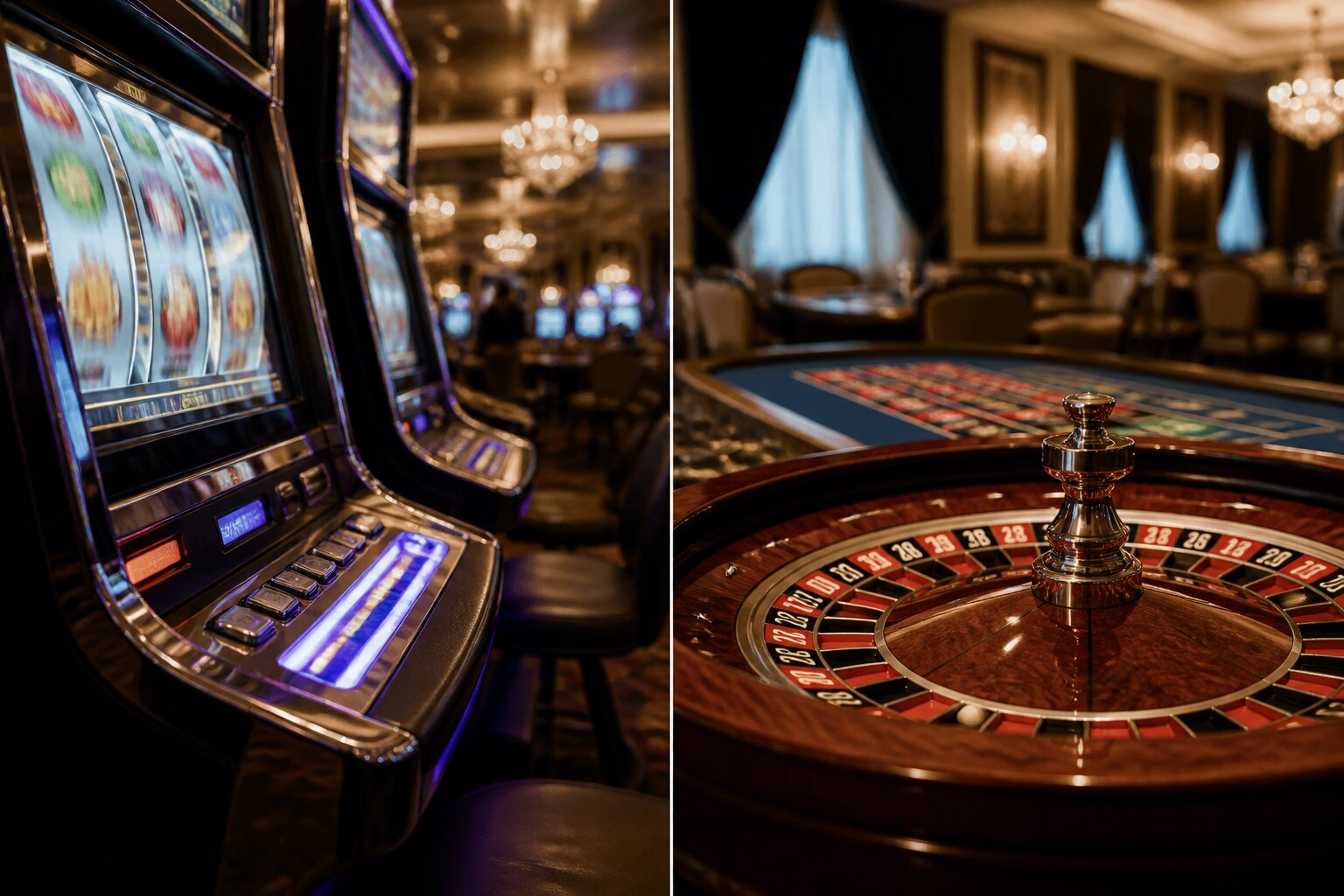
If you’ve ever wandered through a casino or browsed an online gaming site, you’ll know how hard it can be to pick between the bright lights of slot machines and the spinning thrill of roulette. Both games draw plenty of attention but offer very different experiences, from pace to player involvement.
Wondering which might suit your playstyle, budget or mood? This article breaks down how each game works, how the odds compare, what the experience feels like and which might be a better fit for you. Read on to get a clear sense of the differences so you can choose with confidence.
What Are Slot Machines & How Do They Work?
Slot machines are widely available in both casinos and online, and their appeal largely comes from being easy to start and visually engaging. You’ll see reels populated with themed symbols; the objective is to land specific combinations across paylines, with payouts determined by the game’s paytable.
Underneath the surface, every modern slot uses a Random Number Generator (RNG). The RNG determines the symbol positions for each spin, ensuring outcomes are independent and unpredictable. That means past spins do not influence future ones — each play stands on its own.
Slots vary widely in complexity. Some are straightforward three-reel games with a few paylines, while others are multi-reel video slots with dozens of paylines, bonus features, free spins and mini-games that add variety. The game’s Return to Player (RTP) percentage is a useful indicator of how much a slot returns to players over time; many fall between 94% and 97%, but individual titles can differ. This section outlines the mechanics so you know what to expect before you press the spin button.
What Is Roulette & How Is It Played?
Roulette centres on a wheel with numbered pockets and a betting table that offers multiple ways to wager. The basic versions differ by the number of green zero pockets: one zero in the single-zero version and two zeros in the double-zero version, which affects the house advantage.
Play revolves around placing chips on the table to predict where the ball will settle on the wheel. Bets can be placed on single numbers, groups of numbers, odd or even outcomes, or the colour. Payouts reflect the relative risk of the bet: single-number bets pay significantly more than even-money bets, which in turn have higher chances of success.
Each spin is resolved independently, and the structure of the wheel and bets gives roulette a clear mix of high-risk/high-reward options and steadier, lower-return choices. The game’s variety of bet types is part of its long-standing appeal and makes it accessible for newcomers while offering depth for more experienced players.
Payouts & Odds Compared: Slot Machines vs Roulette
Payouts and odds are framed differently in slots and roulette, so comparing them requires understanding each game’s metrics. Slots typically advertise an RTP percentage, which indicates the average return over many plays. An RTP of 95% means that, across a very large number of spins, roughly £95 is paid back for every £100 wagered. RTPs vary by title and provider, so checking a game’s information can help set expectations.
Roulette’s odds are fixed by the wheel layout and bet type. The single-zero version usually carries a house edge of about 2.7%, while the double-zero variant raises that figure to around 5.26%. Payouts are mechanical and tied to the probability of each bet: for instance, a single-number wager has a high payout but low probability, whereas a red-or-black bet offers a near 50/50 outcome with a low payout.
Both games are designed with a house advantage built in, but they express it in different ways. Slots’ RTPs can vary considerably between titles and sessions, while roulette presents predictable odds that are consistent across rounds. Understanding these distinctions helps you match the game to how you prefer to balance risk and reward.
Which Game Has a Better House Edge?
Comparing house edge gives a useful general guide to how much the casino is expected to keep over time. Roulette, particularly the single-zero version, tends to offer a lower house edge than most slots, with roughly 2.7% being typical. The double-zero wheel increases the house edge to about 5.26%.
Slots typically present a wider range of house edges through their varying RTPs. Many slots fall between a 3% and 6% house edge, but some styles of slots — for example, those with very high volatility and large jackpots — can have different effective returns. Because slot RTPs are specific to each game, selecting a higher-RTP title is one way to tilt the statistical balance slightly in your favour.
These figures are averages and theoretical; they describe long-run behaviour rather than the outcome of any single session. If lower average losses are a priority, choosing single-zero roulette or higher-RTP slots will generally reduce the expected margin the house holds.
Are Slot Machines or Roulette More Beginner-Friendly?
Both games are well suited to newcomers, but they offer different learning curves. Slots are plug-and-play: you choose a stake, start the spin and see the result. That simplicity makes them an easy entry point without needing to learn betting systems or table etiquette.
Roulette requires a little more familiarity with bet types and the layout of the table, but the basic options are straightforward to pick up. New players can start with even-money bets while they learn about inside and outside wagers, and many online tables provide clear bet guides to speed up understanding.
Which is more beginner-friendly depends on how comfortable you are with choice. If you prefer minimal decisions and immediate action, slots fit well. If you like a game with a clear decision framework and social interaction, roulette offers that structure while remaining accessible.
Game Experience: Atmosphere, Social Aspect & Entertainment Value
The atmosphere around each game is part of their attraction. Slot play is often solitary and focused, with emphasis on themes, animation and sound design. These elements create a personalised experience that can range from calm to highly stimulating depending on the game’s design.
Roulette tends to be more communal, particularly in physical casinos where players gather around a single table. The shared attention as the wheel turns and the variety of betting options can make it feel like a collective event. Even online, live-dealer roulette replicates some of this social energy through real-time interaction.
Both games provide entertainment in distinct ways: slots through variety and features, roulette through strategic choice and the wheel’s ritual. Which environment you prefer—intimate and immersive or social and structured—will influence which game feels more enjoyable on any given visit.
Common Myths About Slot Machines & Roulette
A number of misconceptions surround both games, so it helps to separate fact from fiction. One persistent belief is that slot machines are “due” to pay out after a run of losses. Because each spin is determined by an RNG and is independent, past results do not affect future outcomes.
Roulette attracts its own myths, such as patterns on the table being predictive of future spins. The wheel’s structure means each spin stands alone, and perceived streaks are not a reliable guide to what happens next.
Systems that claim to overcome the built-in advantage, such as progressive doubling strategies, do not change the fundamental mathematics. Over time, the house edge remains unchanged. Recognising these realities makes it easier to approach each game with realistic expectations.
How to Choose the Best Game for Your Casino Visit
Choosing between slots and roulette comes down to the experience you want and how you manage spending. If you favour variety, themes and a low-commitment playstyle, slots deliver that. If you prefer structured betting options and a more social table atmosphere, roulette may suit you better.
Budget considerations also matter. Both games offer a broad range of stakes, but the way sessions typically unfold differs: slots can be played quickly and repeatedly, while roulette sessions often centre on fewer, more considered bets. Setting deposit or time limits and deciding on an affordable session stake before you start helps keep the focus on entertainment.
Think about how long you want to play, whether you favour interaction, and how much volatility you’re comfortable with. These practical choices will steer you to the game that best matches your visit.
Conclusion: Deciding Between Slot Machines and Roulette
Deciding between slot machines and roulette is a matter of personal preference rather than an absolute “better” choice. Both games offer clear rules, defined odds and distinctive entertainment values. Roulette tends to offer a lower house edge in its single-zero form and a social table experience, while slots provide a wide variety of styles, features and RTPs to suit many tastes.
Choose the game that matches the atmosphere you want and the way you like to stake your money. Keep time and spending limits in place, play only if you are 18 or older, and make choices that preserve control and enjoyment. With those basics covered, your casino visit can be an entertaining experience that fits the way you like to play.
**The information provided in this blog is intended for educational purposes and should not be construed as betting advice or a guarantee of success. Always gamble responsibly.