
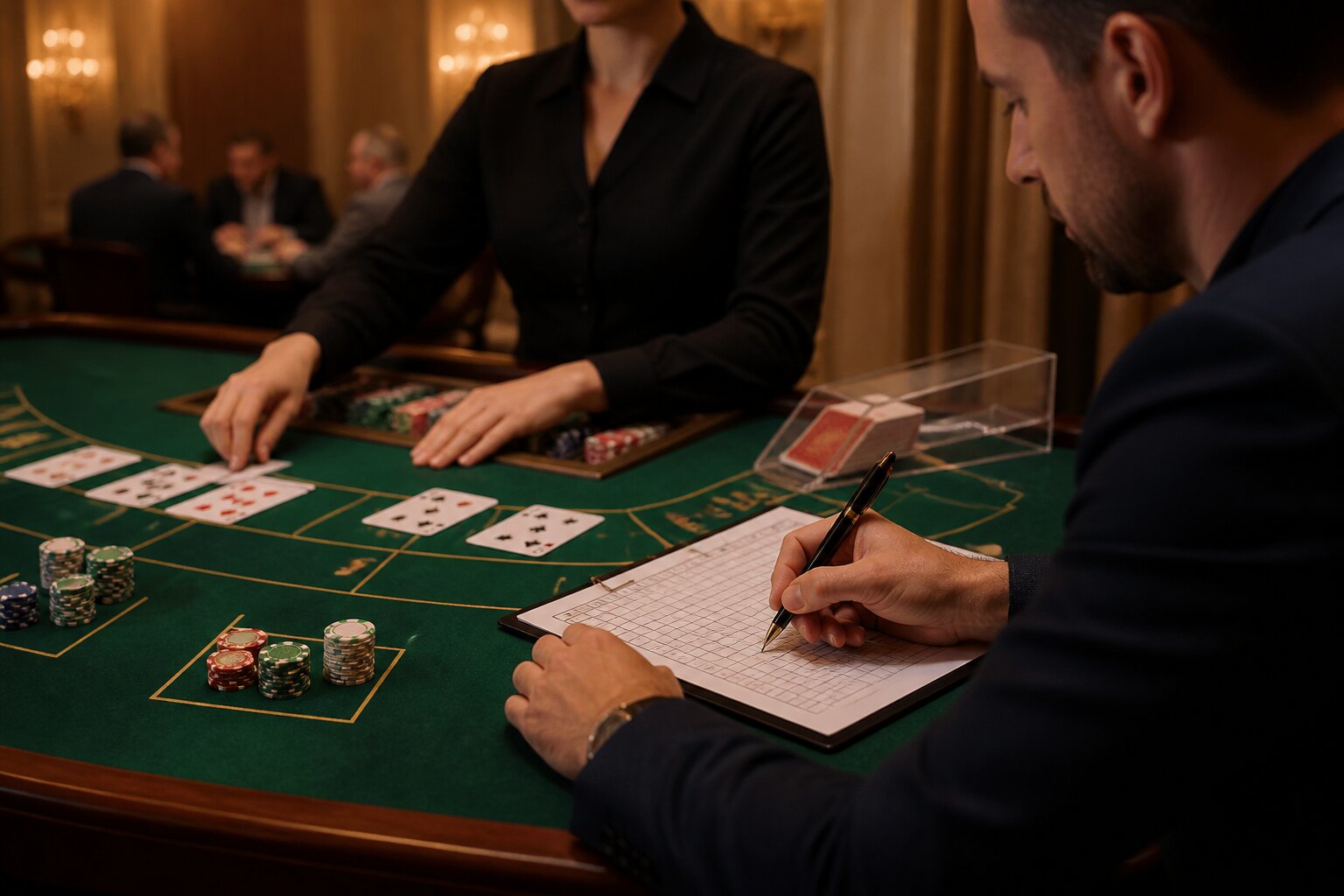
Ever wondered why so many baccarat players sit at the table with a pencil and notepad, jotting down results after each hand? It’s more than habit — it’s about keeping score.
Whether at a casino or on a screen, scorecards are everywhere. Players enjoy tracking hands, spotting sequences and following the game’s flow in a way that feels hands-on and absorbing.
Curious whether this ritual changes outcomes or is simply part of the experience? Read on to discover what scorekeeping does — and does not — do for a baccarat session.
How Does Scoring Work in Baccarat?
Baccarat’s objective is straightforward: predict whether the ‘player’ or ‘banker’ hand will finish with the higher total, or whether the round will be a tie. Each round deals two hands labelled player and banker, and bets are placed before the cards are revealed.
Card values are simple to learn. Number cards from 2 to 9 carry their face value, aces count as 1, and tens and face cards are worth zero. Hands are scored by adding the card values and keeping only the final digit; for example, 7 plus 8 gives 15, which is recorded as 5 in baccarat. When the first two cards total 8 or 9 this is called a natural and the hand ends immediately. If neither hand has a natural, a third card might be drawn according to fixed rules handled by the dealer or software.
This scoring system is what players record on scorecards to build a history of outcomes, which leads into how those scorecards are used at the table.
What Are Baccarat Scorecards & How Are They Used?
Baccarat scorecards are simple records—either printed sheets at the table or digital displays online—where players mark each round’s result. Commonly, outcomes are noted as banker, player or tie, using colours, symbols or short notes to make the sequence easy to scan.
People keep score for different reasons: some like the visual rhythm of wins and losses, others use the record as a personal log of their session. Scorecards do not influence the dealing process or the statistical odds; they are a way for players to stay engaged and to follow the session’s progression.
If a player prefers not to track results, nothing about the game changes. The choice to use a scorecard simply reflects how someone wants to experience the round-by-round action. Next, we’ll look at the main formats players choose for that visual record.
Types of Scoreboards in Baccarat
Scoreboards present the same basic information in different layouts so players can follow trends in whichever way feels clearest. These formats are tools for reference rather than instruments that affect play.
Bead Plate: The Basics Explained
The bead plate, or bead road, displays each round in a simple grid. Each square records an outcome: one colour or symbol for banker, another for player and a third for ties. Results are entered down a column and then across to the next column, creating a chronological visual of the session.
Its strength is clarity: the bead plate is easy to read at a glance and useful for anyone who prefers a straightforward timeline of results.
Big Road and Derived Roads: What’s the Difference?
The big road groups consecutive wins into columns, helping to highlight streaks by extending a column downward when the same side keeps winning, and starting a new column when the result changes. Derived roads — including the big eye boy, small road and cockroach pig — are alternative displays that transform the big road into patterns using different marks and rules.
These derived roads are more abstract: they don’t record outcomes in the same way but instead offer another perspective on how results have unfolded. Each format gives players a different visual cue, and choosing one comes down to personal preference rather than performance.
Why Do Players Track Baccarat Scores?
Scorekeeping turns passive observation into an active pastime. Many players enjoy watching how sequences develop and find that keeping a record makes the session feel more engaging. It can also be part of the social side of play, providing a common reference for table conversation.
Others value the scorecard as a session log—something that helps them remember how long they played or the pattern of outcomes over time. For those who like structure, it brings a pleasing order to otherwise quick rounds.
While scorekeeping enhances engagement for many, it should be seen as a way to make the game more interesting rather than as a method to alter statistical outcomes. With that in mind, it’s useful to consider how accurate a scorecard’s implications really are.
How Accurate Is Score Tracking in Baccarat?
A scorecard is accurate as a historical record of previous rounds, but it offers no predictive power. Each hand in baccarat is statistically independent: the result of one round does not change the probabilities governing the next. Tracking outcomes does not alter the house edge or provide foresight into future hands.
Players often find scoreboards helpful for visualising flow, yet that visual pattern should not be mistaken for foresight. Records are useful for engagement and personal bookkeeping, and should be treated as such rather than as a basis for forecasting.
Understanding this distinction helps keep the focus on enjoyment and measured play. With misconceptions cleared up, it’s worth addressing some of the more persistent myths around scorekeeping.
Common Myths About Baccarat Scorekeeping
Several myths persist about scorekeeping, and clearing them up makes for a calmer, better-informed approach to the game. A frequent claim is that past outcomes can be used to predict the next result; in reality, no sequence of earlier hands changes the odds that govern subsequent deals.
Another misconception is that more complex scoreboards or exhaustive tracking confer an advantage. While they can make the game feel more strategic, derived roads and intricate marks do not increase winning chances. Similarly, the idea that a current “streak” guarantees future wins misunderstands how independent rounds operate.
Accepting that scorekeeping is a tool for engagement rather than a strategy prevents misplaced expectations and keeps the activity enjoyable.
Should You Track Scores When Playing Baccarat?
Whether to track scores comes down to how you prefer to experience the game. For many, a scorecard adds structure and invites a closer read of what’s happening at the table. It can make sessions more sociable and provide a neat record of play.
On the flip side, over-focusing on patterns can distract from the simple pleasures of the game and lead to unrealistic beliefs about control over outcomes. If keeping a record starts to change how someone bets or how they feel about their play, it may be better to stop or simplify the tracking.
Practical choices—setting a budget for a session, taking breaks and keeping play within personal limits—help ensure the activity stays enjoyable. If gambling ever stops being fun or becomes hard to control, seeking help and support is an important step.
Whether you choose to track scores or not, the key is to play in a way that feels enjoyable and responsible, keeping the experience firmly in the realm of entertainment.
**The information provided in this blog is intended for educational purposes and should not be construed as betting advice or a guarantee of success. Always gamble responsibly.