
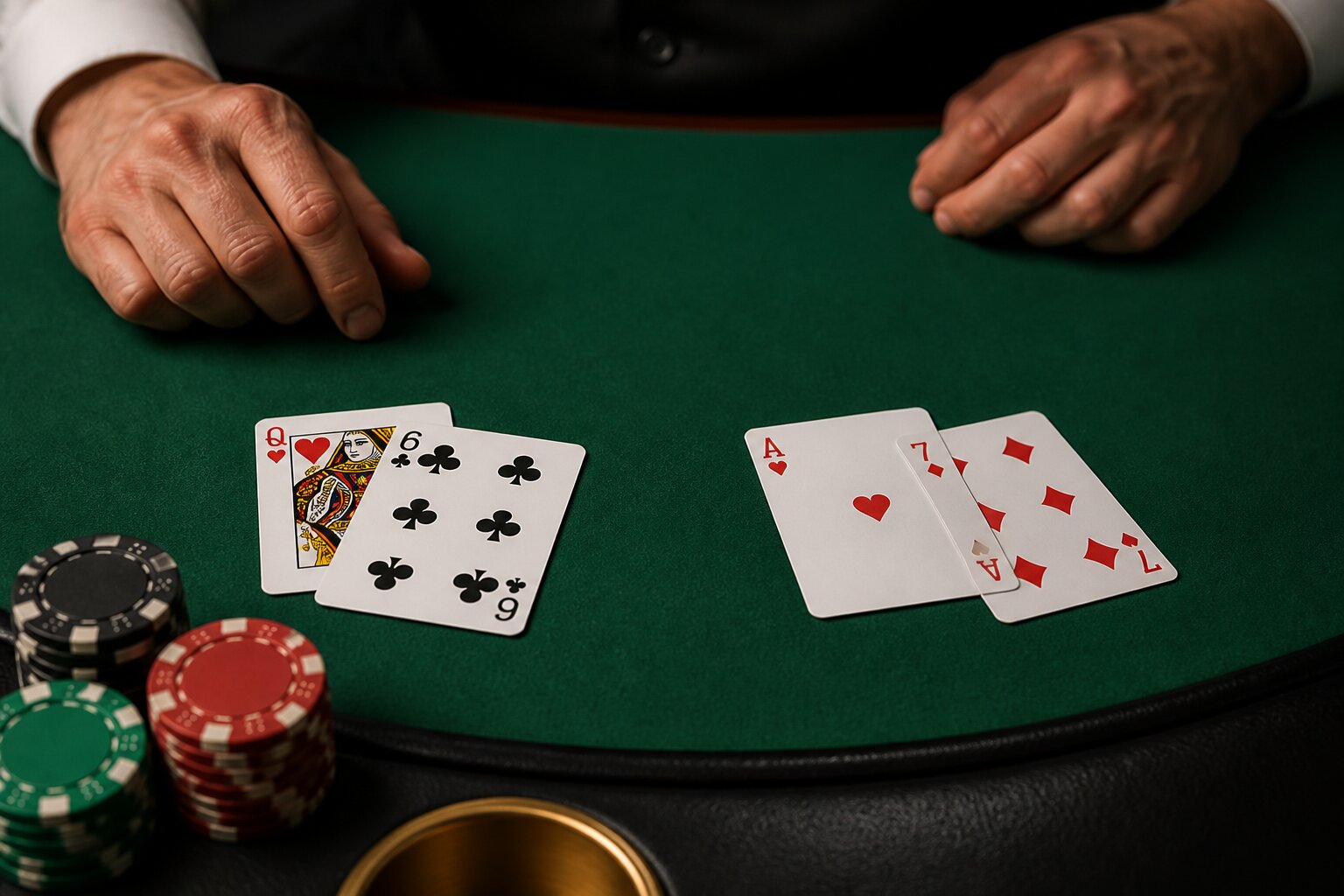
Blackjack is more than trying to get as close to 21 as possible; there is skill in how you play each hand. One of the earliest concepts to learn is the difference between hard and soft hands, because it affects every decision you make during a round.
Knowing what these terms mean and how they change your options can improve your play. Whether you’re starting out or looking to sharpen your approach, this guide will explain the ideas clearly and show how to use them at the table.
What Is a Hard Hand in Blackjack?
A hard hand is any hand that does not contain an Ace counted as 11. Totals are fixed in value, so every card you add changes the total exactly as shown. That lack of flexibility is the defining feature.
Examples make this simple. A 10 and a 7 is a hard 17. A 5, a 6 and a King add to a hard 21. If your hand includes an Ace that must count as 1 to avoid going over 21, it is also treated as a hard hand — for instance, Ace-7-10 becomes a hard 18 because the Ace cannot be 11 without breaking 21.
With hard hands the risk of exceeding 21 when drawing another card is higher than with soft hands, so tactical caution matters.
What Is a Soft Hand in Blackjack?
A soft hand contains an Ace that can be counted as 11 without busting. The Ace’s dual value, either 1 or 11, gives this hand type its flexibility and changes the way you might respond to the dealer’s upcard.
Take Ace and 6: that is soft 17, because the Ace can be 11 or 1. If you then take a 5, the Ace would be treated as 1 to keep the total within 21, converting the soft hand into a hard 12. The ability to switch the Ace’s value is what lets you take more risk with a soft hand while still protecting the total.
Soft hands often create better opportunities to improve the total without immediate danger of busting, but they still require thoughtful play.
Key Differences Between Hard and Soft Hands
The technical difference is straightforward: whether an Ace can act as 11. Practically, that translates into different risk profiles and strategic choices.
Hard hands are more rigid; each additional card is a fixed increase in total and can push you over 21 quickly. Soft hands offer a buffer because the Ace can shift from 11 to 1 to absorb a high card. In other words, soft hands permit more aggressive draws when the total is low, while hard hands demand more caution as totals rise.
This difference affects not only whether players hit or stand but also how the dealer’s rules and table conditions are evaluated.
How Do You Play Hard Hands in Blackjack?
Playing a hard hand revolves around managing the immediate risk of busting. Higher hard totals commonly justify standing because the incremental value of another card is unlikely to outweigh the chance of going over 21.
For example, most players adopt conservative play on hard 17 or higher, while hard totals in the low teens prompt a different mood: the potential gain from another card can sometimes be worth the risk. Decisions also depend on the dealer’s visible card and the house rules in play, so context matters.
Good play with hard hands blends an awareness of probabilities with personal limits on how much risk to take.
How Should You Play Soft Hands in Blackjack?
Soft hands invite a different approach because the Ace cushions the impact of a high draw. With soft totals in the lower range, such as a soft 13 to soft 16, the opportunity to improve is often attractive since the Ace can revert to 1 if needed.
When a soft hand reaches higher values, like soft 19 or soft 20, the incentive to stand increases because those totals are already favourable. Still, the dealer’s behaviour and the table rules — such as whether the dealer hits or stands on soft 17 — can change the optimal response.
In practice, soft hands let you balance potential improvement against the strength of what you already hold.
Why Does the Dealer Treat Hard and Soft Hands Differently?
Dealers follow fixed rules so play is consistent for everyone. Those rules take the Ace’s flexibility into account because soft hands can convert into hard hands after a hit. For example, an Ace with a six counts as soft 17, but if the dealer draws a card that makes the Ace count as one, the hand becomes hard. This conversion is why the dealer’s treatment of soft hands must be explicitly defined.
Typically, dealers must stand on hard 17 or higher. With soft 17 there is variation between venues and games, for example:
- some tables require the dealer to hit soft 17,
- others require the dealer to stand on soft 17.
This difference matters because a dealer who hits soft 17 introduces extra variability into the outcome of a round. Hitting on soft 17 gives the dealer a chance to improve to a stronger hand, but it also increases the chance of busting. The overall effect alters the likelihood of different results and has a small effect on the house edge.
Understanding whether the dealer hits or stands on soft 17 helps you judge how aggressive you should be when you hold a soft hand. It is sensible to check the table rules or casino information before you play so you know whether the game is H17 or S17 and can adjust your decisions accordingly.
Are There Common Myths About Hard and Soft Hands?
A few persistent misunderstandings can misdirect play. These myths can cause players to make choices that do not match the situation at the table.
Common misconceptions include:
- Soft hands are inherently superior to hard hands; while soft hands offer more flexibility because the Ace can count as 1 or 11, that flexibility does not guarantee better results in every situation.
- There is a single foolproof trick for playing soft or hard hands; there is not one, because outcomes follow probability and the specific dealer rules for the game you are playing.
- The way a hand plays in one session will determine how it will play in future rounds; each deal is an independent event and should be evaluated on its own merits.
Some players also think a hand’s type affects future rounds. In reality, each deal is independent, so decisions should be based on the current cards, the dealer’s upcard, and the rules in play rather than assumptions about past or future hands.
The best approach is to combine a clear grasp of how Aces work with sensible decision-making based on probability and the table rules. Remember to play responsibly, as gambling involves risk.
Mistakes to Avoid With Hard and Soft Hands
Failing to recognise whether a hand is hard or soft is a common slip that leads to poor choices. Treating every Ace the same or ignoring how the dealer’s rules interact with your hand can lead to unnecessary losses.
Other errors include taking a card on a high hard total where busting is likely, or standing too early on a soft total that could be improved. Equally important is managing stakes in a way that fits your comfort level and prevents impulsive decisions.
Thinking ahead, staying aware of the hand type, and keeping wagers within agreed limits will make the experience clearer and more controlled.
Summary: Choosing the Right Approach for Each Hand
Knowing whether your hand is hard or soft sets the scene for every decision you make at the table. Hard hands demand restraint as totals rise, while soft hands create opportunities to be more adventurous because the Ace can adjust its value.
Balance knowledge of hand types with sensible limits so play stays enjoyable and within your control. If you want to practise these ideas further, try playing low-stakes rounds or simulated games before increasing your exposure.
Play with awareness, keep to limits you are comfortable with, and treat each hand as a single challenge to apply what you’ve learned.
**The information provided in this blog is intended for educational purposes and should not be construed as betting advice or a guarantee of success. Always gamble responsibly.