
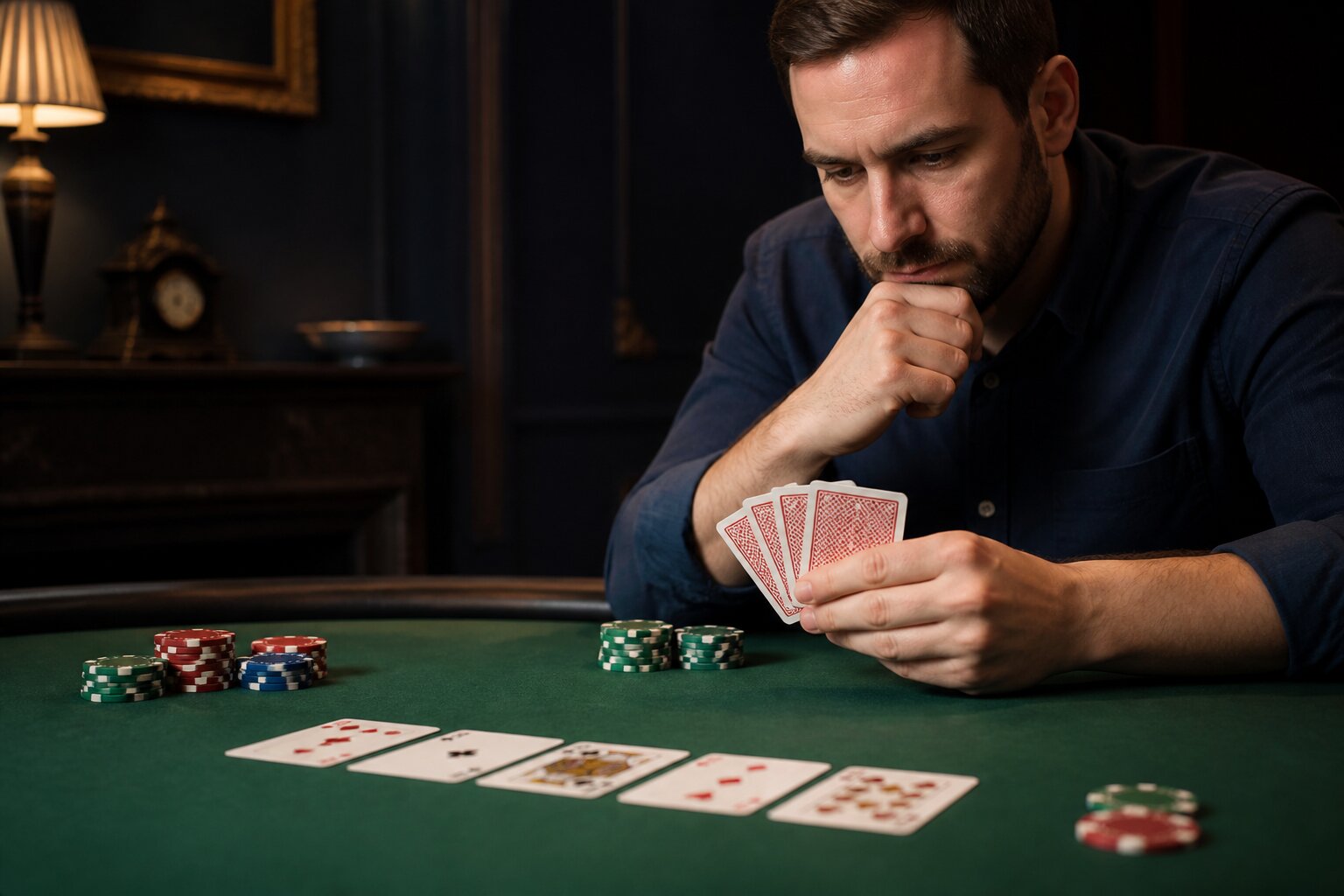
Fancy yourself a bit of a poker ace? You’ve probably heard stories of sharp players tracking cards to gain an edge. But what’s actually possible at the table, and where do the myths end?
Card counting is often portrayed as a neat, mathematical shortcut — yet poker is a different game from those where counting can work. This article walks through what card counting means, why it doesn’t transfer easily to poker, the common misunderstandings, and the ethical side of trying to gain an advantage. Read on to separate fact from fiction and find practical, lawful ways to improve your game.
What Is Card Counting & How Does It Work?
Card counting is a method of monitoring which cards have been dealt so you can estimate what remains in the deck. In games where many cards are visible and the deck isn’t shuffled between rounds, it’s possible to use simple mental arithmetic to spot a changing balance of high and low cards and adjust bets or strategy accordingly.
The technique itself is just careful observation and memory, not a special talent. Counters typically assign values to cards and keep a running total, using that figure to infer whether the deck favours certain outcomes. That approach depends on visibility of cards and a stable deck composition over multiple hands.
In poker, however, most cards stay hidden and the deck is shuffled frequently. That makes sustained, reliable tracking extremely difficult. While players may note revealed or folded cards to inform a decision, that practice is about gathering information, not formal card counting as applied in other games.
It’s sensible to view card counting as an informational tool rather than a guaranteed route to winning. Use any technique to help you make clearer decisions, but remember that observation alone doesn’t ensure better results.
Is Card Counting Possible in Poker Games?
Card counting in the strict sense is rarely feasible in poker. Poker rounds tend to show only a handful of cards—the hands of individual players and, in games with community cards, just those shared cards. After most hands the deck is shuffled, which breaks any running tally of card composition.
Some specific poker environments can afford more card visibility. For example, in very small home games where the deck isn’t shuffled often, or in formats where mucked cards are exposed, a skilled observer might pick up useful information. Even then, what they gain is limited and fragile: opponents adjust, shuffles happen, and human memory is fallible.
What works reliably in poker is reading opponents’ behaviour, understanding range of hands, and making mathematically sound choices based on the information actually available at the table. Observational skills—such as recognising betting patterns or timing tells—are far more valuable than attempting to track the unseen cards.
Key Differences Between Poker & Blackjack Card Counting
The environment in which a game is played determines whether counting can help. In blackjack, many cards are exposed each round, and the dealer may deal several hands before reshuffling. That repeated exposure creates conditions where tracking card distribution can influence betting choices.
Poker operates differently. Players compete against each other and only a small portion of the deck is revealed per hand. Regular shuffling further undermines any long-term counting strategy. The alternating flow of betting, bluffs and folds also means that even when some cards are known, their strategic implications differ from casino table games.
Because of these structural differences, techniques developed for one game do not transfer cleanly to the other. The mental tools poker players rely on are about ranges, pot odds and opponent tendencies; counting cards in the blackjack sense simply has no comparable role in typical poker play.
Common Myths About Card Counting in Poker
Popular culture has helped spread a few persistent myths. One is the idea that a skilled player can memorise most of a deck during play and then exploit that knowledge for regular wins. In real poker rooms, where cards are concealed and shuffled often, that level of recall is impractical.
Another myth is that card counting can substitute for poker fundamentals. In truth, success stems from a mix of decision-making, position awareness, bankroll discipline and reading opponents. Remembering a handful of revealed cards might occasionally influence a choice, but it doesn’t replace core strategy.
A final misconception is that counting is commonplace among top professionals. While experienced players will note earlier revealed or mucked cards when relevant, they rarely depend on systematic counting. Their edge comes from consistent analysis of game situations and behavioural cues, not memorising the deck.
Do Professional Poker Players Use Card Counting?
Top professionals focus on methods that yield consistent, repeatable advantages. They monitor betting patterns, range tendencies and stack dynamics, and they apply probability and game theory to make decisions. Observing previously exposed cards is one piece of that puzzle when it’s available, but it isn’t the same as standard card counting.
Professionals treat information subtly: a revealed card might narrow an opponent’s likely holdings, or show that a particular sequence of actions is unlikely. That type of inference is part of skilled play, not an attempt to track the full composition of the deck.
Legal & Ethical Aspects of Card Counting in Poker
Legality and fairness are key considerations. In most regulated venues, the rules require games to be fair and transparent. Systematically attempting to gain an unfair advantage—by exploiting dealer mistakes or interfering with shuffles—would breach those principles and could lead to sanctions.
Ethically, poker relies on an implicit agreement that players compete within the same practical limits. Using available information is part of good play; seeking out ways to break the intended playing conditions is not. Operators and venues enforce rules to preserve fairness and maintain player trust.
As a player, staying within established rules and behaving with integrity keeps the game enjoyable for everyone. If you’re unsure whether a tactic is acceptable, ask floor staff or consult the venue’s guidelines rather than assuming it’s allowed.
Impact of Card Counting on Poker Gameplay
Because counting is impractical in typical poker settings, its direct impact on outcomes is minimal. The elements that drive results are decision quality, position, pot odds, and how well you balance aggression with caution when the situation demands it.
Observational awareness does matter: noticing how opponents reacted to a previous river card or recalling a key showdown can influence later choices. Those observations are tactical, situational and short-term, unlike a counting system that claims to track remaining deck composition.
In practice, players who invest time in studying hand ranges, expected value calculations and opponent tendencies will see steadier improvement than those trying to apply counting techniques from other games. The best results come from integrating facts you can reliably observe into your overall strategy.
Summary: Should You Attempt Card Counting in Poker?
When you weigh the evidence, card counting in the traditional sense is not a promising route for poker. The game’s structure, limited card visibility and frequent shuffling mean any attempt to track the deck will usually be ineffective.
If your aim is to get better at poker, concentrate on observations that genuinely matter: analysing opponents, understanding probabilities that apply to revealed cards, and making sound strategic choices. Play within the rules, and use site or venue tools for managing your play if you need them. Keep the focus on skill, fair competition and enjoying the challenge poker provides — that’s the approach that pays off in the long run.
**The information provided in this blog is intended for educational purposes and should not be construed as betting advice or a guarantee of success. Always gamble responsibly.